How to Improve Working Memory (Evidence-Based, Practical)
Marcos Hernanz
Founder & CEO
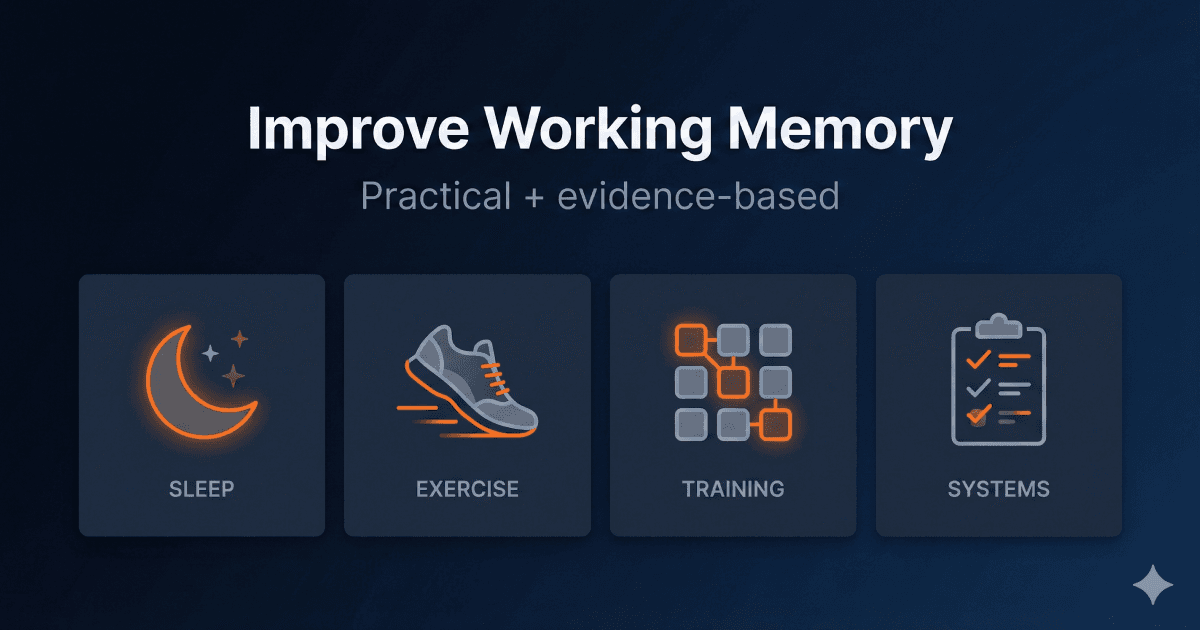
Working memory is your brain's "mental workspace". It is heavily involved in focus, learning, and reasoning.
If you want the concept explained clearly, start with Working memory explained.
This post is a practical guide: what you can do that reliably helps, what is overhyped, and how to build a routine you can keep.
1) Reduce working-memory load (the fastest win)
Before you try to "increase" capacity, reduce the load.
Simple systems that work:
- Write the next 3 steps on a note.
- Use checklists for repeated workflows.
- Keep one task open at a time.
- Reduce interruptions (notifications off).
This often improves real-life performance more than any training.
2) Sleep (non-negotiable)
Sleep strongly affects attention and working memory.
If your sleep is unstable, n-back scores will be noisy and your day-to-day focus will feel fragile.
Practical steps:
- Keep a consistent wake time.
- Get morning light.
- Avoid late caffeine.
3) Exercise (one of the most reliable "brain boosters")
Regular aerobic exercise correlates with better cognitive function and mental health.
Practical minimum:
- 20-30 minutes, 3x/week.
4) Stress and rumination management
Stress consumes working memory.
If your mind is busy, your workspace is smaller.
If anxiety/rumination is part of the problem, read N-back and anxiety (with realistic expectations).
5) Targeted training (n-back)
Once your basics are in place, you can add training.
N-back is a common choice because it forces updating and interference control.
Start here:
Avoid the pitfalls: N-back training mistakes.
6) Nutrition basics (keep it boring)
The best cognitive nutrition advice is usually not exotic supplements.
- Eat enough protein.
- Avoid large blood-sugar swings.
- Hydrate.
If you're sleep deprived, no supplement will outwork that.
7) Set realistic expectations
You can improve how you perform in demanding tasks by:
- reducing load,
- improving sleep,
- training attention control,
- building systems.
But be skeptical of guaranteed claims.
For the big picture on transfer and why many programs fail, read Does brain training work?.
Try Cogniba
If you want structured n-back training with progress tracking:
Further reading
- Simons et al. (2016). https://doi.org/10.1177/1529100616661983