What Is the N-Back Task? A Simple, Evidence-Based Explanation
Marcos Hernanz
Founder & CEO
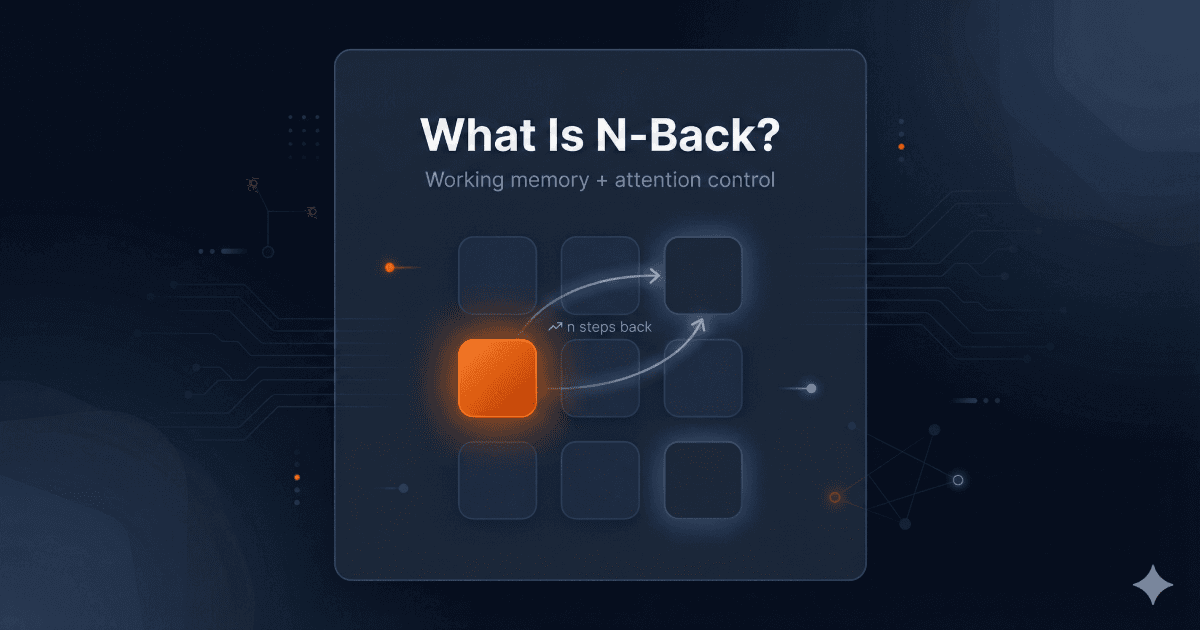
If you've ever seen phrases like "2-back" or "dual n-back" and wondered what they mean, you're not alone. The n-back task is a simple (but demanding) exercise used in cognitive psychology to study working memory and attention control.
This post explains what n-back is, how it works, and how to try it in a way that is actually useful.
The n-back task in one minute
In n-back, you see (or hear) a sequence of items one at a time. Your job is to decide whether the current item matches the one from n steps earlier.
- 1-back: compare to the previous item.
- 2-back: compare to the item two steps earlier.
- 3-back: compare to the item three steps earlier.
Most implementations are a stream of letters, locations on a grid, sounds, or shapes. Each trial is either a match or a non-match, and you respond accordingly.
Why researchers like n-back
The reason n-back shows up in so many papers is that it stresses a few core skills at once:
- Updating: you must continuously refresh what's currently in working memory.
- Interference control: you must resist confusing similar items from nearby trials.
- Sustained attention: you must keep your mind "on task" for the full session.
If you want the bigger picture on what working memory is and why it matters, start with Working memory explained.
Single n-back vs dual n-back
- Single n-back usually means one stream (e.g., position only).
- Dual n-back means two streams at the same time (e.g., position + sound/letter).
Dual n-back is harder and can be more motivating for some people, but it is also easier to burn out on.
If you're choosing between them, read Single vs dual n-back.
What n-back is (and is not)
N-back is not a "memory trick" where you memorize the whole list. If you try to hold everything at once, you'll overload.
N-back is more like a moving window. At any moment, you only need the last n items and the ability to compare quickly.
That is why many people experience n-back as "mental tension" rather than calm memorization.
Does training n-back transfer to real life?
This is the controversial part.
Some studies and meta-analyses report improvements on related cognitive tests, but broader "IQ increases" are not guaranteed and the evidence is mixed. The best, most honest expectation is:
- You will almost certainly get better at the task you practice.
- You may improve in nearby skills like attention control and working-memory updating.
- Larger claims require more caution.
For the balanced view, read:
How to try n-back without wasting your time
If you're going to try n-back, the most important factor is consistency.
- Start with a level where you can stay engaged (often 2-back).
- Train in short sessions (10-20 minutes).
- Track accuracy; don't chase a high level on a bad day.
Use the practical plan here: How to train n-back (4-week plan).
If you want a guided version with progress tracking, see pricing and the deeper explanation on research.
Further reading
- Jaeggi et al. (2008). "Improving fluid intelligence with training on working memory." https://doi.org/10.1073/pnas.0801268105
- Au et al. (2014). "Improving fluid intelligence with training on working memory: a meta-analysis." https://doi.org/10.3758/s13423-014-0699-x
- Simons et al. (2016). "Do 'Brain-Training' Programs Work?" https://doi.org/10.1177/1529100616661983
- Baddeley (2000). "The episodic buffer: a new component of working memory?" https://doi.org/10.1016/S1364-6613(00)01538-2