N-Back Training Mistakes That Kill Results (And How to Fix Them)
Marcos Hernanz
Founder & CEO
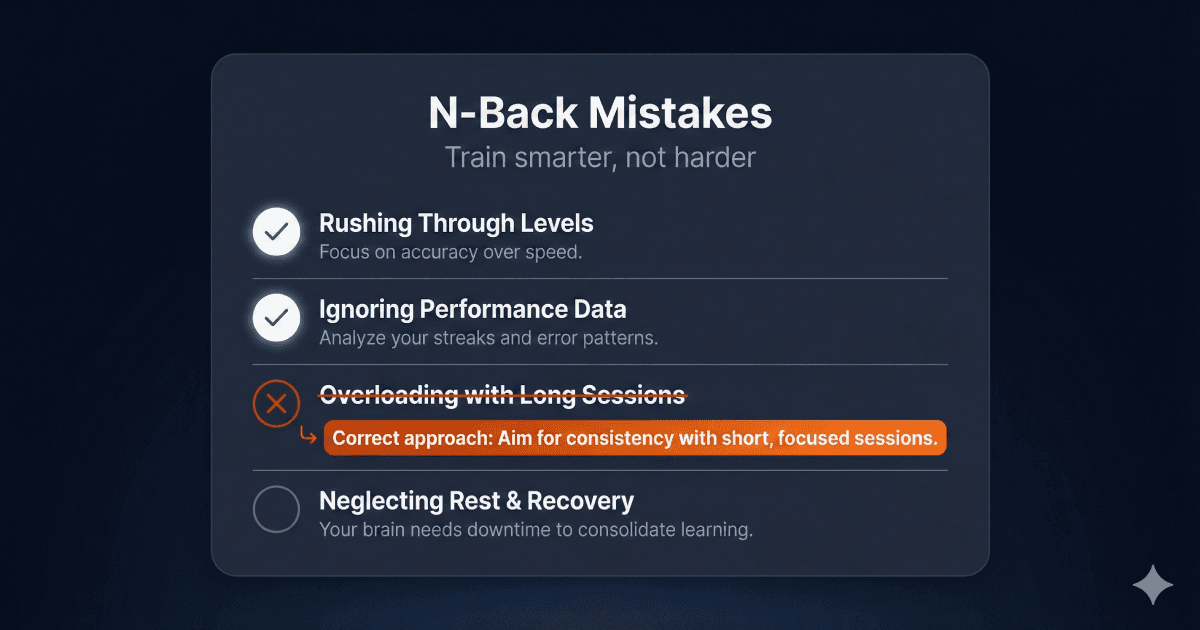
N-back training can be extremely productive, but it's also easy to waste weeks doing it in a way that looks like "effort" and produces very little.
If you're starting out, begin with What is the n-back task? and the routine in How to train n-back (4-week plan).
This post covers the mistakes that most often cause plateaus, burnout, or fake progress.
Mistake 1: Chasing difficulty instead of accuracy
The most common failure mode is trying to push level every session.
Why it hurts:
- You end up practicing "panic mode" instead of stable attention.
- Your performance becomes noisy, so you can't tell if you're improving.
Fix:
- Aim for consistent, meaningful accuracy.
- Increase difficulty only when performance stabilizes.
If you want a progression rule you can follow, use How to train n-back (4-week plan).
Mistake 2: Inconsistency (the hidden killer)
N-back is skill training. If you train 3 days, stop for 10, then come back, you keep paying the "warm-up tax" and never build momentum.
Fix:
- Pick a sustainable schedule: 3-5 sessions/week, 10-20 minutes.
- Make the session easy to start (same time, same place, same setup).
Mistake 3: Training while distracted
If you're checking messages between blocks, listening to a podcast, or letting the environment pull your attention around, you're not training the skill n-back is best at: attention control under load.
Fix:
- Phone in another room.
- Full-screen mode.
- Quiet environment.
- Treat it like a workout: short, focused, done.
For why this matters, read Can n-back improve focus?.
Mistake 4: Making sessions too long
Long sessions often feel virtuous, but fatigue changes the task. Instead of practicing clean updating and interference control, you practice "limping to the finish".
Fix:
- Keep sessions short: 10-20 minutes.
- Stop if accuracy collapses.
- Prefer another short session tomorrow over forcing 45 minutes today.
Mistake 5: Switching protocols constantly
Single vs dual. Visual vs auditory. Different pacing. Different rules.
If you change everything every week, you never learn what works.
Fix:
- Keep one protocol for 2-4 weeks.
- If you want variety, make one controlled change at a time.
If you're deciding between variants, read Single vs dual n-back.
Mistake 6: Ignoring the basics (sleep and stress)
N-back performance is sensitive to:
- Sleep deprivation
- Stress
- Multitasking
If your life is chaotic, your graph will be chaotic. That does not mean training is pointless, but it does mean you should interpret results carefully.
Fix:
- Track a simple note next to sessions ("good sleep" / "bad sleep").
- On bad days, keep the session short and focus on consistency.
For broader tactics, see How to improve working memory.
Mistake 7: Not measuring anything
If you don't track your performance (even loosely), you can't tell:
- whether you're improving,
- whether you're overreaching,
- whether changes in routine actually help.
Fix:
- Track accuracy and difficulty (or level) over time.
- Review weekly, not daily.
Read N-back results timeline for what "normal" progress often looks like.
A simple "train smarter" checklist
Before you start a session:
- Is the environment distraction-free?
- Is the session short (10-20 minutes)?
- Am I aiming for stable accuracy, not just a higher level?
After you finish:
- Record accuracy.
- Add a note if sleep/stress was unusually high.
Use Cogniba to stay consistent
If you want structured n-back training with progress tracking:
Further reading
- Simons et al. (2016). "Do 'Brain-Training' Programs Work?" https://doi.org/10.1177/1529100616661983
- Au et al. (2014). "Improving fluid intelligence with training on working memory: a meta-analysis." https://doi.org/10.3758/s13423-014-0699-x