N-Back Results Timeline: What Changes After 1, 4, and 8 Weeks?
Marcos Hernanz
Founder & CEO
If you're training n-back, it's normal to ask: "When will I see results?"
The most useful way to think about progress is in layers:
- Getting better at the task (almost guaranteed).
- Building consistency and attention control (very likely).
- Broad transfer to unrelated skills (possible, but not guaranteed).
If you want the basics first, read What is the n-back task?.
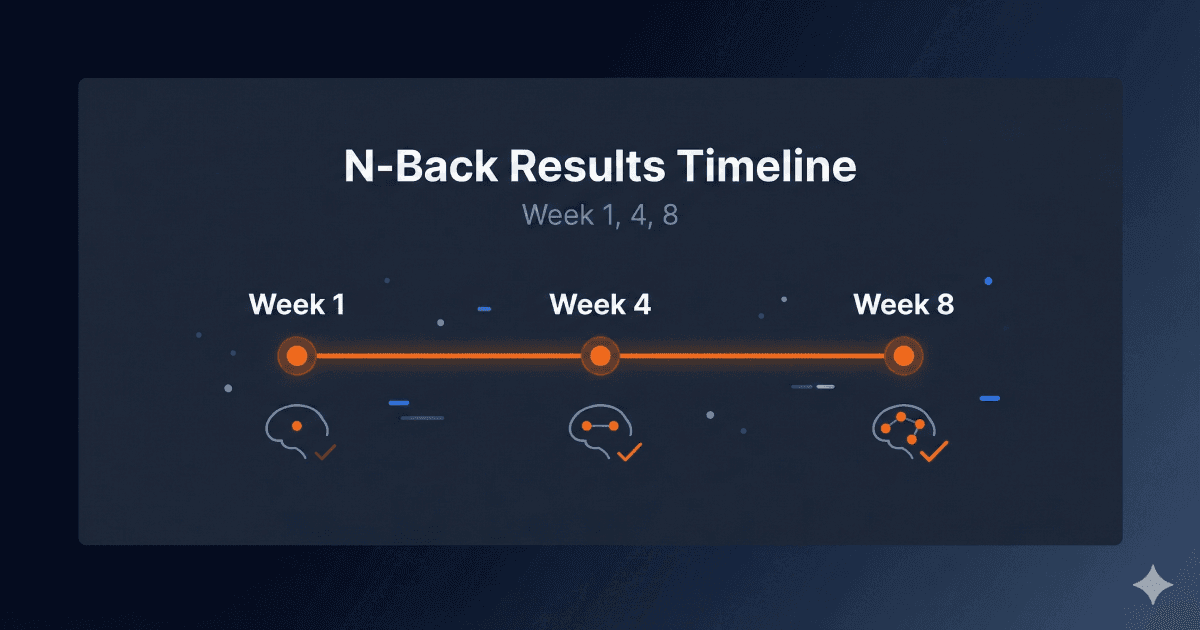
Week 1: the learning curve
In the first week, most improvement is about understanding the rules and reducing errors caused by confusion.
Common signs of progress:
- You stop feeling lost.
- You can hold the last n items without constant "resetting".
- Your accuracy stabilizes.
What to do:
- Keep sessions short (10-15 minutes).
- Don't chase difficulty.
Use How to train n-back (4-week plan).
Week 2-4: consistency and stability
This is the phase where training becomes a habit and your performance becomes less noisy.
Common signs of progress:
- You can maintain focus for the full session.
- Your accuracy becomes more predictable day to day.
- You start noticing how sleep and stress affect performance.
What to do:
- Train 3-5 sessions/week.
- Increase difficulty only when stable.
If you feel stuck early, check N-back training mistakes.
Week 5-8: incremental gains (and realism)
After the first month, progress tends to become slower and more incremental.
This is also where people start asking about "real-life" effects.
What to expect (the honest version):
- You will likely continue improving at n-back.
- You may notice better attention control in cognitively demanding situations.
- Large claims (like guaranteed IQ boosts) are not reliable.
For the balanced view of IQ claims, read Does n-back increase IQ?.
For the bigger picture of brain-training transfer, read Does brain training work?.
How to measure progress without fooling yourself
Track trends, not single sessions.
Good measures:
- Average accuracy per week.
- Highest stable difficulty (not a one-off).
- Consistency (how many sessions you completed).
Avoid:
- Judging by one amazing day.
- Judging by one terrible day.
What to do when you plateau
Plateaus are normal.
Try one change at a time:
- Improve environment (remove distractions).
- Reduce session length (higher quality).
- Stabilize difficulty for 1-2 weeks.
If you want a focus-specific approach, read Can n-back improve focus?.
Where Cogniba fits
If you want structured sessions and progress tracking:
Further reading
- Au et al. (2014). https://doi.org/10.3758/s13423-014-0699-x
- Simons et al. (2016). https://doi.org/10.1177/1529100616661983