Executive Function Explained: The Skills Behind Self-Control and Focus
Marcos Hernanz
Founder & CEO
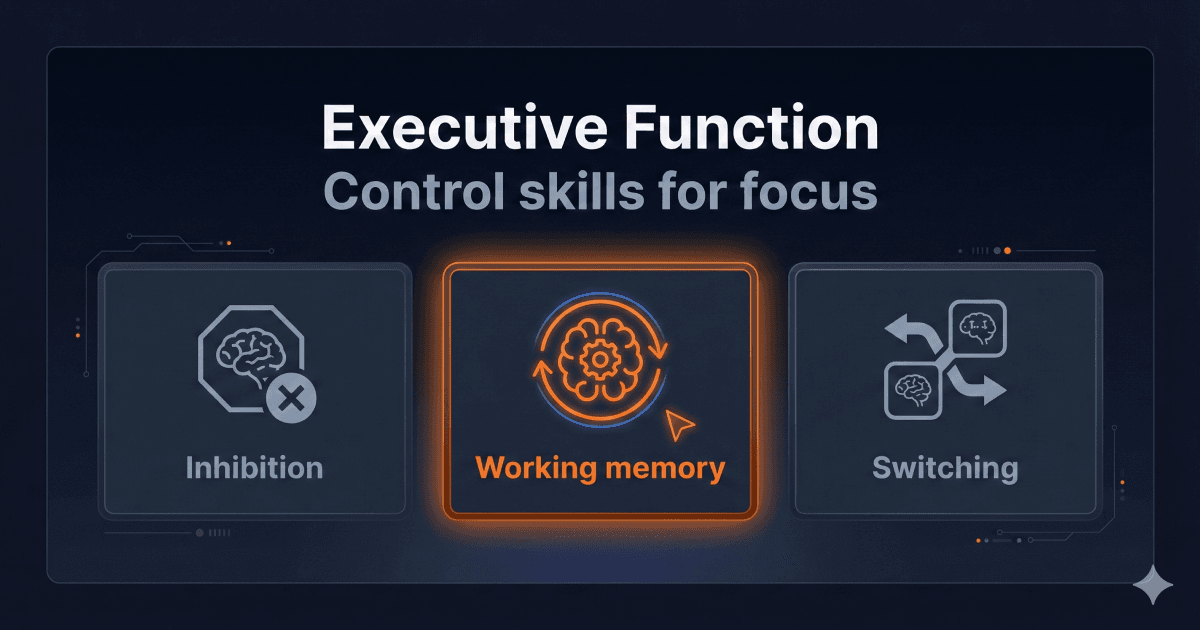
Executive function is the set of mental control skills that help you do what you intended instead of what is easiest in the moment.
If you've ever:
- opened your phone "for one thing" and lost 20 minutes,
- reread the same paragraph three times,
- or switched tasks so often you forgot what you were doing,
you've felt executive function (and its limits).
This post explains what executive function is, what it is made of, and what helps in real life.
Executive function in plain language
Think of executive function as your brain's control layer.
It helps you:
- hold a goal in mind,
- ignore distractions and impulses,
- and switch strategies when the situation changes.
Executive function is closely related to working memory, because you can't control what you can't keep "online".
The 3 core skills (a useful model)
Different researchers slice this differently, but this breakdown is practical:
- Working memory: hold and manipulate information (your mental workspace).
- Inhibition: stop impulses and ignore interference.
- Shifting: switch tasks/strategies without getting lost.
If one of these is weak, focus gets fragile.
How executive function shows up day to day
Executive function isn't only about productivity. It's also about self-regulation:
- Studying: keeping the thread of an argument, resisting "easy" distractions.
- Programming: holding state across files and recovering after interruptions.
- Anxiety/rumination loops: attention repeatedly captured by the same thought.
If you're a student, start with N-back for students. If you code, start with N-back for programmers.
How to strengthen executive function (what works)
Most gains come from two categories: reduce load and practice control.
1) Reduce load (the fastest win)
When working memory is overloaded, executive function looks "worse".
Simple fixes:
- Write the next 3 steps down.
- Keep one task open at a time.
- Remove notifications during focus blocks.
This is the core of how to improve working memory.
2) Protect the basics (sleep + stress)
Executive control is sensitive to sleep deprivation and stress.
If your life is chaotic, your focus will be chaotic. Don't interpret that as "lack of willpower".
3) Practice attention control (training)
Training helps most when it targets a specific control skill and you stay consistent.
One common choice is n-back, because it forces you to keep a goal active while resisting interference.
- Learn the task: What is the n-back task?
- Follow a plan: How to train n-back (4-week plan)
- Avoid wasted effort: N-back training mistakes
For the honest view on transfer, read Does brain training work?.
A simple daily routine (10-25 minutes)
If you want something sustainable:
- 10-15 minutes of n-back (focused, no multitasking)
- 2 minutes: write a single sentence goal for your next work block
- 45-90 minutes of deep work
That "goal sentence" is a small executive-function hack: it keeps the target in working memory.
Try Cogniba
If you want structured training with progress tracking:
Further reading
- Miyake et al. (2000). The unity and diversity of executive functions. https://doi.org/10.1037/0096-3445.129.1.49
- Diamond (2013). Executive functions. https://doi.org/10.1146/annurev-psych-113011-143750