Task Switching Explained: The Real Cost of Context Switching
Marcos Hernanz
Founder & CEO
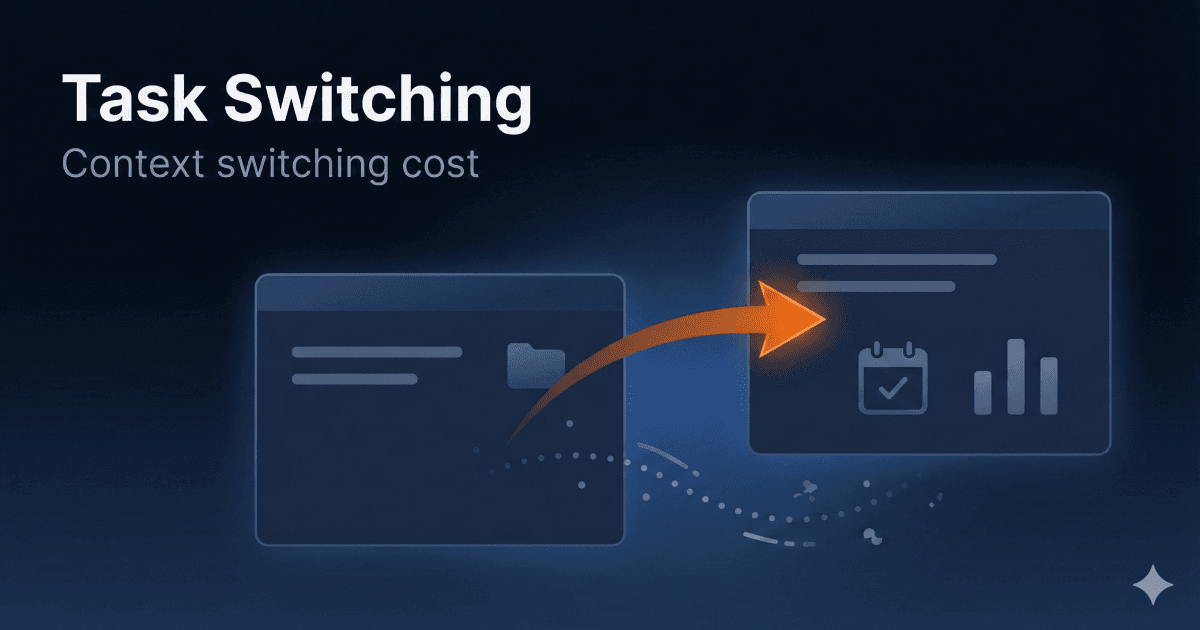
Task switching is when you move from one task to another.
It feels productive ("I'm getting so much done"), but it often destroys real progress because each switch has a cost.
That cost is paid in working memory.
If you want the foundation, start with Working memory explained.
What task switching really costs
When you switch tasks, your brain has to:
- drop the current context,
- load the next context,
- and rebuild the goal state.
Even if each switch is "only a minute", the hidden cost is loss of momentum and increased errors.
This is why deep work feels different: you stop paying the switching tax.
Why it happens so easily
Two reasons:
- Modern tools make switching frictionless.
- Switching provides a quick hit of novelty.
This is where inhibitory control matters: resisting the impulse to switch.
How to reduce context switching (practical)
1) Batch communications
Pick two windows per day to check messages.
If you check continuously, you're building a switching habit.
2) Externalize the next step before you stop
Before you leave a task, write:
- the next action,
- the current hypothesis,
- and where to resume.
This makes re-entry dramatically faster.
3) Use "one task" blocks
Even 45 minutes helps.
If you're a programmer, this is especially important. See N-back for programmers.
4) Train control under load (optional)
If you want a training task that pressures attention control, n-back is one option:
Avoid the classic mistakes: N-back training mistakes.
Try Cogniba
If you want structured training with progress tracking:
Further reading
- Monsell (2003). Task switching. https://doi.org/10.1016/S1364-6613(03)00028-7
- Rubinstein, Meyer, Evans (2001). Executive control of cognitive processes in task switching. https://doi.org/10.1037/0096-3445.130.4.685
- Leroy (2009). Why is it so hard to do my work? Attention residue. https://doi.org/10.1287/orsc.1090.0506