Inhibitory Control Explained: The Hidden Skill Behind Focus
Marcos Hernanz
Founder & CEO
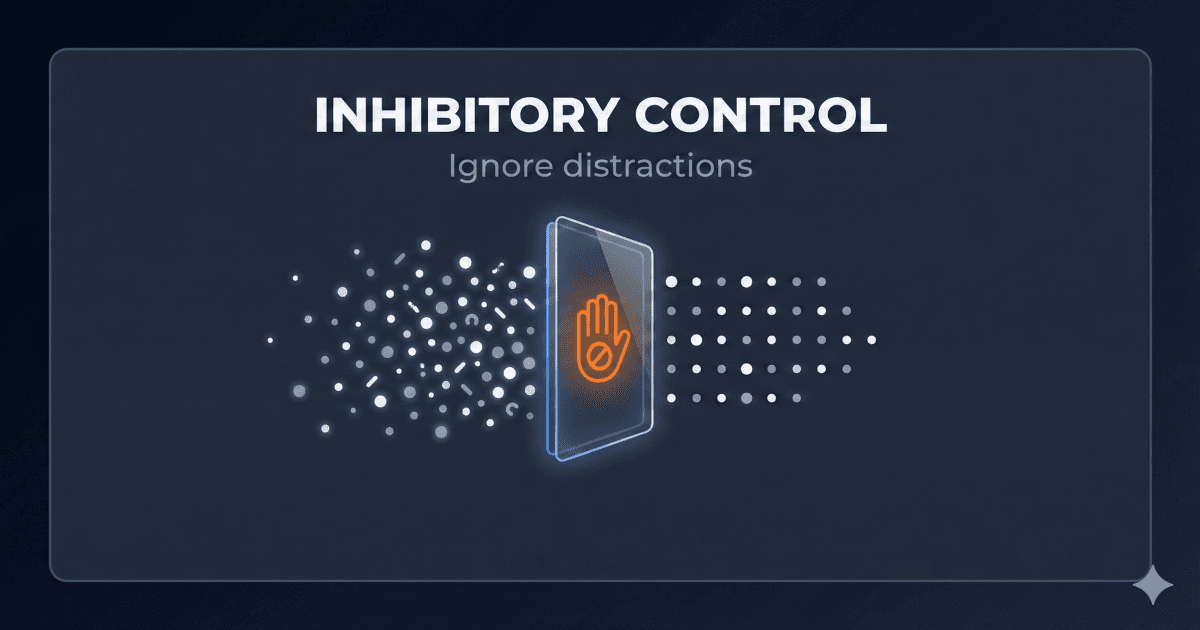
Inhibitory control is the ability to not do something.
Not clicking the notification. Not checking the tab. Not responding to the impulse that pulls you away from your plan.
It's one of the core ingredients of executive function and a big reason why focus feels easy some days and impossible on others.
What inhibitory control actually means
In plain language, inhibitory control is:
- stopping an impulse,
- ignoring irrelevant information,
- and resisting interference from habits.
It's not "being disciplined". It's a cognitive skill that gets weaker when your brain is overloaded.
Real-life examples
You use inhibitory control when you:
- keep reading instead of checking your phone,
- stay on your workout instead of quitting early,
- avoid replying emotionally in a heated moment,
- or keep one task open instead of chasing novelty.
Why inhibitory control fails
Common reasons it collapses:
- Working memory overload: if you can't hold the goal in mind, the distraction wins by default.
- Sleep deprivation: attention control becomes noisy.
- Stress: your brain prioritizes threat signals and short-term relief.
Start with the foundation: Working memory explained.
How to train inhibitory control (the practical way)
There are two layers: environment and practice.
1) Environment (the underrated layer)
If distractions are always within reach, you're "spending" inhibition all day.
Try:
- Phone in another room during focus blocks.
- Full-screen mode.
- One tab for the task.
This is the fastest way to improve performance without relying on willpower.
2) Practice control under load
Tasks that force interference control can help you practice the skill directly.
N-back is one popular example because it requires sustained attention and resisting confusion from similar items:
If you try it, avoid common traps: N-back training mistakes.
A simple rule that makes inhibition easier
When you notice distraction:
- Name it ("urge to check")
- Write the urge-trigger down if needed
- Return to the next tiny step ("read the next paragraph")
This sounds small, but it shifts you from impulse-following to goal-following.
Try Cogniba
If you want structured n-back training with progress tracking:
Further reading
- Diamond (2013). Executive functions. https://doi.org/10.1146/annurev-psych-113011-143750
- Aron (2007). The neural basis of inhibition. https://doi.org/10.1016/j.neuron.2007.09.016