Attention Residue Explained: Why Switching Tasks Feels Mentally Sticky
Marcos Hernanz
Founder & CEO
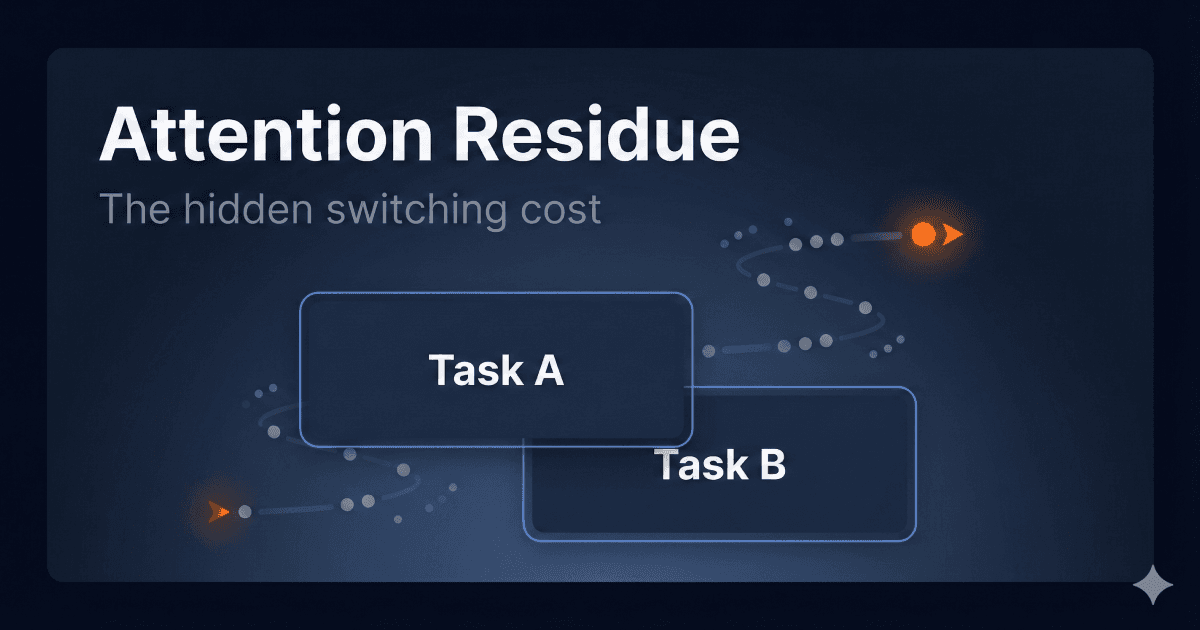
Attention residue is what you feel when you stop one task and your mind keeps "running" it in the background.
You switch to the next thing, but part of your attention stays glued to the previous context.
The result:
- slower ramp-up,
- more errors,
- and that "why can't I focus?" feeling.
If context switching is a problem for you, start with Task switching explained.
What attention residue is (plain language)
When you change tasks, your brain doesn’t instantly unload the old goal.
Some of the old task state remains active:
- open loops (unfinished decisions),
- partially solved problems,
- and emotional residue (stress, urgency, doubt).
That leftover state competes for working memory capacity.
Why it happens
Two common drivers:
- Unfinished work: the task is incomplete, so your brain keeps it "alive".
- High cognitive load: the task used a lot of working memory, so clearing it takes time.
This overlaps with Cognitive load theory explained: overload makes it harder to stabilize a new goal.
Signs you're paying the residue tax
You might be experiencing attention residue if you:
- reread the first few lines every time you return,
- keep checking the previous tab "one more time",
- or feel a vague pull to go back and "close the loop".
If you recognize that pull, you’re not broken. You’re just running a limited-capacity system. See Working memory explained.
How to reduce attention residue (practical)
1) End with a re-entry note
Before you switch, write 2-3 lines:
- what you just did,
- what the next step is,
- and any key decision / assumption.
This externalizes context, so working memory doesn’t have to keep it active.
2) Reduce the number of switches
If you can, use focus blocks:
- 45-90 minutes single-task,
- then a short break,
- then switch.
This is the simplest way to stop paying the switching fee all day.
3) Close loops aggressively
Residue gets worse when tasks are left ambiguous.
If you can’t finish, define a clear stopping point:
- “I’m waiting on X.”
- “Next step: write Y.”
4) Train attention control under load (optional)
If you want to practice keeping a goal stable while resisting interference, n-back is one option.
- Learn the task: What is the n-back task?
- Use a plan: How to train n-back (4-week plan)
- Avoid wasted reps: N-back training mistakes
This is closely related to executive control. See Executive function explained.
Try Cogniba
If you want structured training with progress tracking:
Further reading
- Leroy (2009). Why is it so hard to do my work? Attention residue. https://doi.org/10.1287/orsc.1090.0506