Metacognition Explained: Thinking About Your Thinking
Marcos Hernanz
Founder & CEO
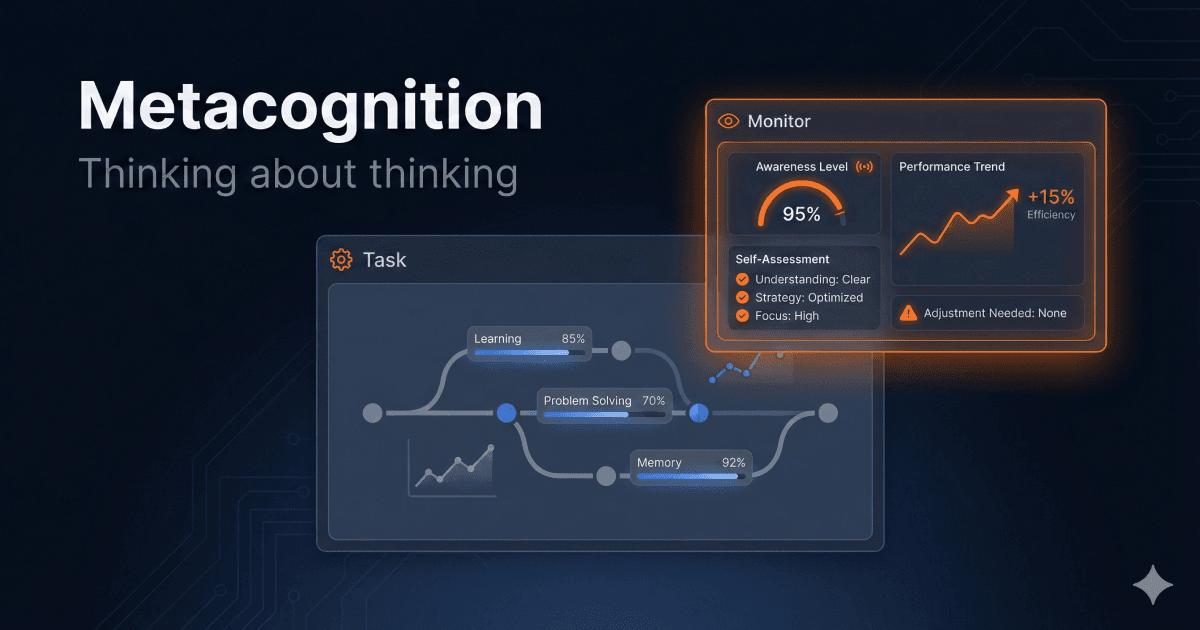
Metacognition is the skill of monitoring and adjusting your thinking.
It’s how you notice:
- “I’m confused and need a different approach,”
- “I’m overconfident,”
- or “I’m drifting and need to reset.”
It’s a quiet multiplier for learning and focus.
What metacognition looks like in real life
Metacognition is present when you:
- stop rereading and test yourself instead,
- notice you’re guessing and slow down,
- or recognize you’re overloaded and externalize steps.
That last one connects directly to Cognitive load theory explained.
Why it improves learning
Without metacognition, you can spend hours “studying” while staying confused.
With metacognition, you:
- detect confusion earlier,
- choose better strategies,
- and avoid wasting effort.
This matters because working memory is limited. See Working memory explained.
How to build metacognition (practical)
1) Use tiny check-ins
During a focus block, ask:
- “What am I doing right now?”
- “What is the next step?”
- “What would count as done?”
If you can’t answer quickly, your goal isn’t stable.
That’s an executive function issue, not a motivation issue. See Executive function explained.
2) Prefer active recall
Instead of rereading, test yourself.
Even one question forces you to reveal what you actually know.
3) Track confidence, not just correctness
After a session, write:
- what you got right,
- what you got wrong,
- and what you were confident about (but shouldn’t have been).
This calibrates learning faster than time spent.
4) Train attention control under load (optional)
Metacognition is easier when attention is stable.
If you want a structured task to practice goal maintenance, n-back is one option:
If you use it, keep difficulty calibrated: How to set n-back difficulty.
Try Cogniba
If you want structured training with progress tracking: