Working Memory Capacity Explained: Why You Can Only Hold So Much
Marcos Hernanz
Founder & CEO
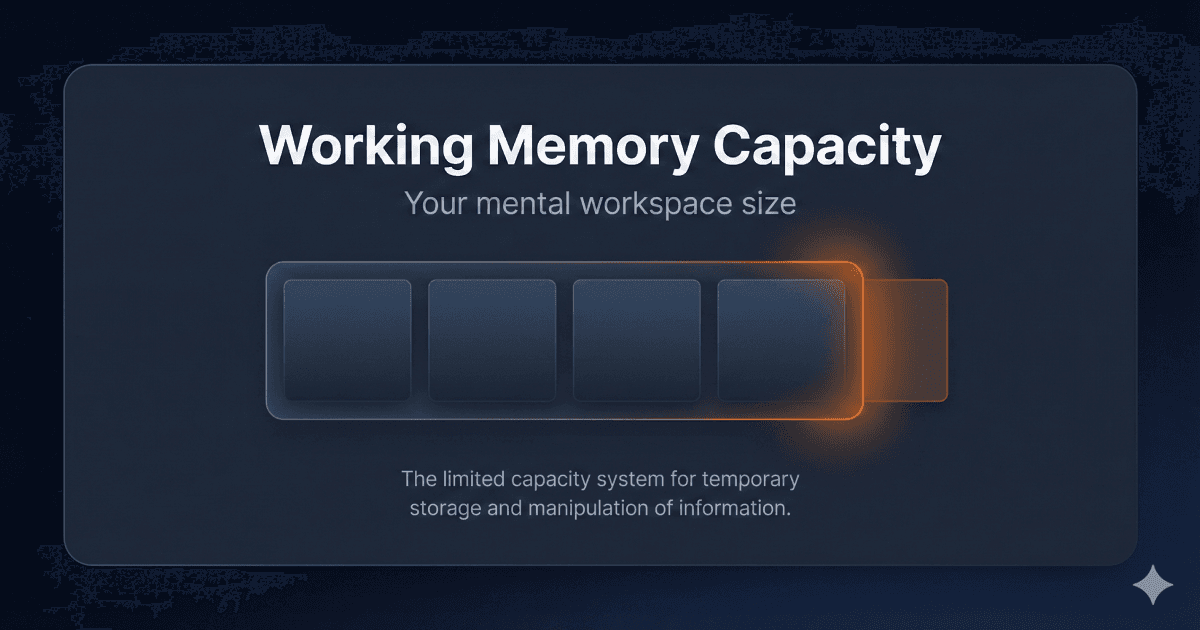
Working memory capacity is the limit on how much information you can hold "online" at once.
When you hit that limit, focus feels fragile:
- you reread,
- you lose the thread,
- you make simple mistakes,
- and switching tasks becomes painful.
If you’re new to the concept, start with Working memory explained.
Capacity, in plain language
Think of working memory as a desk.
Capacity is how much can fit on the desk before it becomes clutter and you start dropping things.
This is not about intelligence in a moral sense. It’s a system constraint.
What affects working memory capacity day to day
Even if your baseline capacity is stable, your effective capacity changes with conditions.
Common reducers:
- Sleep loss (slower updating, more noise)
- Stress / anxiety (more intrusive thoughts)
- Distraction (attention constantly stolen)
- High cognitive load tasks (too many elements at once)
This is why Cognitive load theory explained matters: lowering extraneous load gives you capacity back.
If rumination is eating your workspace, also see N-back and anxiety.
“How many items can I hold?”
You’ll see different numbers in the literature because "item" depends on chunking.
In real life, what matters is this:
- You can hold a small number of chunks.
- Better chunking makes each chunk carry more meaning.
So the practical question becomes: how do you increase useful chunks (and reduce clutter)?
How to work with limited capacity (fast wins)
1) Externalize steps
Write down the next 3 actions.
This is the single best hack for high-load work because it stops working memory from being your only storage.
2) Reduce switching
Switching burns capacity because you have to reload context.
If you constantly bounce, you’ll feel “stupid” even when you aren’t.
Start here: Task switching explained and Attention residue explained.
3) Use a “single sentence goal”
Before a focus block, write one sentence:
"In the next 60 minutes, I will ___."
That sentence keeps the goal stable, which supports executive function and makes inhibitory control easier.
Can you increase capacity?
Two layers:
- Support it (sleep, stress management, environment).
- Train it (practice updating and interference control).
If you want a broad, evidence-based set of levers, read How to improve working memory.
If you want a training task, n-back is a common option:
Try Cogniba
If you want structured training with progress tracking: