How to Set N-Back Difficulty: The Sweet Spot for Progress
Marcos Hernanz
Founder & CEO
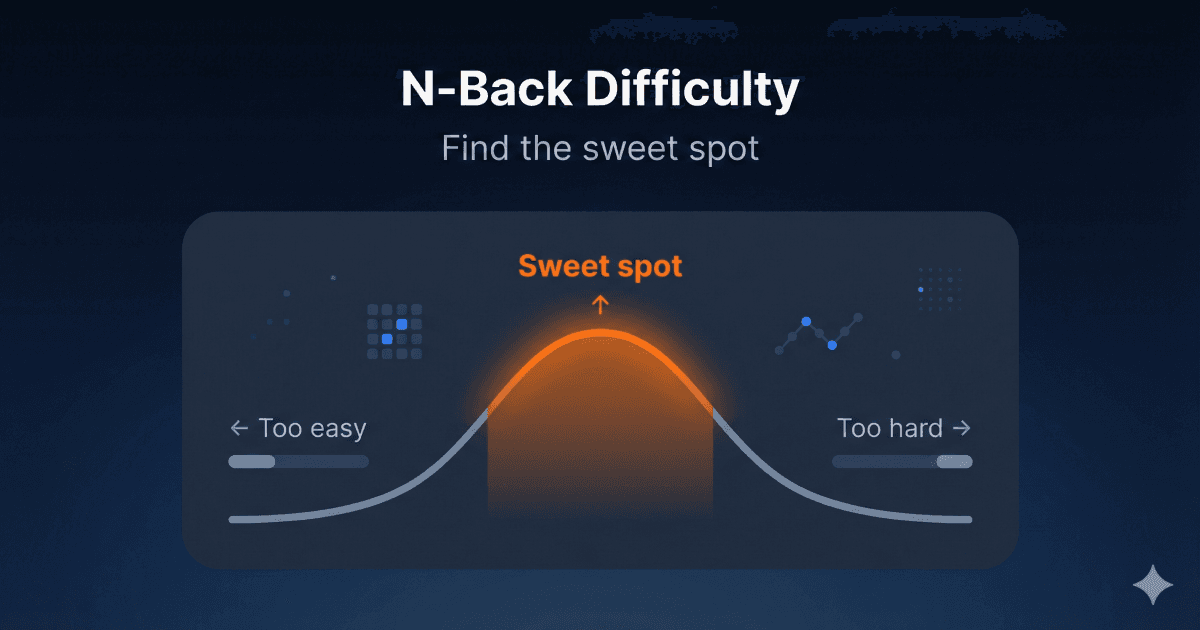
If your n-back training feels confusing, it’s often a difficulty problem.
The right level should feel effortful but manageable.
Too easy and you stop adapting. Too hard and you train frustration (or quit).
If you’re brand new, start with What is the n-back task? and How to train n-back (4-week plan).
What “difficulty” means in n-back
Difficulty is how hard it is to keep the correct target in working memory while resisting interference.
It usually increases when you:
- raise
n(2-back -> 3-back), - speed up stimuli,
- add a second modality (dual n-back),
- or reduce cues / increase similarity.
For the modality decision, see Single vs dual n-back.
The most useful metric: accuracy band
You don’t need perfect scoring.
You need an accuracy band that signals “challenge + control”.
Practical target:
- Aim to spend most sessions around 70-85% accuracy.
Why:
- Above that, it often becomes too easy.
- Below that, working memory is overloaded and learning gets noisy.
This is basically cognitive load management. See Cognitive load theory explained.
A simple rule for adjusting difficulty
Use a rolling window of recent blocks (or recent sessions).
- If you’re consistently > 85%, increase difficulty slightly.
- If you’re consistently < 65-70%, decrease difficulty slightly.
- If you’re in the band, stay put and build consistency.
Small adjustments beat big jumps.
Common mistakes
Mistake 1: chasing the highest n
Higher n is not the goal.
The goal is training attention control and updating under load.
If you want the honest view on outcomes, read Does brain training work?.
Mistake 2: changing settings every session
If you constantly change protocols, you never stabilize.
Pick a setup, run it for a week, then adjust.
Mistake 3: training when you’re fried
Sleep loss and stress reduce your effective working memory.
On low-energy days, you can reduce difficulty and still get a high-quality session.
This is also why Executive function explained and Inhibitory control explained matter: self-regulation sets the conditions for good reps.
A “good session” checklist
- You can stay engaged without zoning out.
- You make errors, but not constantly.
- You finish feeling challenged, not defeated.
If you want a timeline for what to expect, see N-back results timeline.
Try Cogniba
If you want structured training with progress tracking: