N-Back Accuracy Target: What Score Should You Aim For?
Marcos Hernanz
Founder & CEO
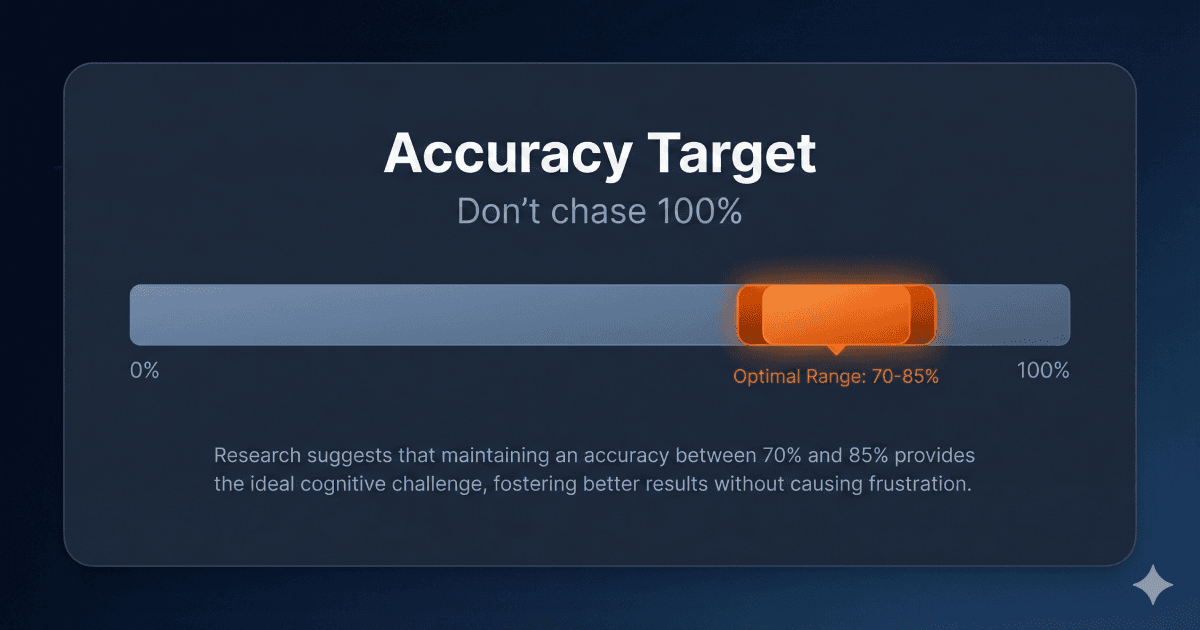
If you’re doing n-back and wondering “what score should I aim for?”, the surprising answer is:
Not 100%.
Perfect accuracy usually means the task is too easy to drive adaptation.
If you’re new, read What is the n-back task? and follow a routine from How to train n-back (4-week plan).
Why accuracy matters
Accuracy is a proxy for how much load you’re putting on working memory and attention control.
- Too high: not enough challenge.
- Too low: overload, sloppy reps, frustration.
This mirrors the idea in Cognitive load theory explained: learning works best when load is high enough to be meaningful but not chaotic.
A practical accuracy target
For most people, a good working band is:
- 70-85% accuracy for most blocks/sessions.
If your system reports accuracy differently (hits/false alarms), aim for a similar “mostly correct but not perfect” band.
What to do if you’re above the band
If you’re consistently above ~85%:
- increase difficulty slightly,
- or increase speed slightly,
- or (later) consider dual n-back.
For modality choices, see Single vs dual n-back.
What to do if you’re below the band
If you’re consistently below ~65-70%:
- lower difficulty,
- slow down,
- shorten the session,
- or train earlier in the day when you have more mental energy.
If anxiety/rumination is interfering, see N-back and anxiety.
The most common trap: changing everything
If you change protocol every session, your data becomes meaningless and motivation drops.
Keep the setup stable for a week, then adjust.
This is one of the core points in N-back training mistakes.
If you want a single rule
Aim to finish sessions thinking:
“That was hard, but I stayed in control.”
That feeling is closely linked to executive control. See Executive function explained and Inhibitory control explained.
Try Cogniba
If you want structured training with progress tracking: