Sustained Attention Explained: How to Stay Focused Longer
Marcos Hernanz
Founder & CEO
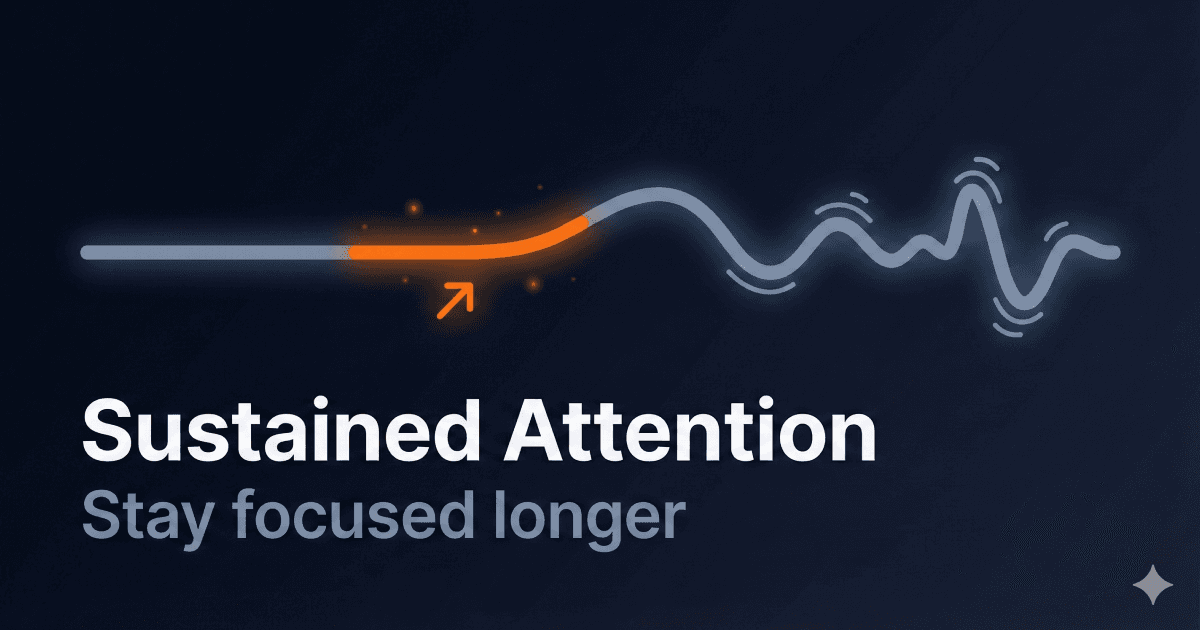
Sustained attention is the ability to keep focus on one task for an extended period.
It’s what you need for:
- deep reading,
- complex problem solving,
- and work that requires keeping a goal stable.
If you struggle with shorter focus cycles, start with How to improve your attention span.
Sustained attention vs “trying harder”
Sustained attention isn’t pure willpower.
It’s a combination of:
- working memory capacity,
- inhibitory control,
- and environment design.
If your mental workspace is overloaded, sustained attention collapses. See Working memory capacity explained and Cognitive load theory explained.
Why sustained attention breaks
Common failure modes:
- distraction exposure (easy switching)
- attention residue from unfinished tasks
- high cognitive load without external supports
- fatigue (sleep + stress)
If you’re constantly switching, read Task switching explained and Attention residue explained.
How to build sustained attention (practical)
1) Reduce switching opportunities
Make the default path “stay on task”.
- phone out of reach
- notifications off
- one-tab rule during focus blocks
This reduces how often you have to spend inhibitory control.
2) Use focus blocks
Sustained attention is easier inside a boundary.
Try:
- 45-90 minutes of single-task work
- 5-10 minutes break
3) Lower cognitive load
If your task has many moving parts, externalize steps.
Write down:
- the next 3 actions,
- key variables,
- and open questions.
This protects working memory.
4) Train control under load (optional)
If you want to practice keeping a goal active while resisting interference, n-back is one option.
To keep sessions in the right zone, use N-back accuracy target.
What progress looks like
Progress is usually:
- fewer “breaks” in the first 30 minutes,
- faster return after interruption,
- and less mental drag.
If you want a realistic timeline, see N-back results timeline.
Try Cogniba
If you want structured training with progress tracking: